The Guwahati Ring Road project is expected to transform connectivity in Northeast India through a major bypass, Brahmaputra bridge and upgraded highway infrastructure.
The ambitious Guwahati Ring Road Project is expected to emerge as one of the most transformative infrastructure developments in Northeast India, with officials and planners projecting major improvements in urban mobility, trade connectivity and regional economic growth.
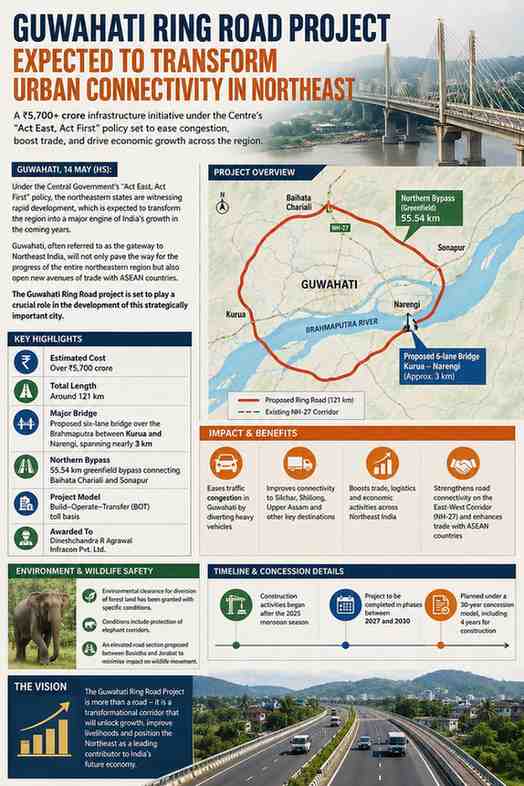
Planned at an estimated cost of more than ₹5,700 crore, the large-scale project is aimed at easing chronic traffic congestion in Guwahati while simultaneously strengthening transportation links across the northeastern region.
The infrastructure initiative is also expected to support the Central Government’s broader “Act East, Act First” policy, which focuses on integrating Northeast India more closely with national and international trade corridors, particularly with ASEAN nations.
Authorities believe the project could significantly enhance Guwahati’s role as the principal gateway to the Northeast and a strategic commercial hub for future economic expansion.
Major Push for Northeast Development
The northeastern region has witnessed accelerated infrastructure development in recent years, with road, rail, airport and logistics projects being prioritised to improve connectivity and boost investment.
Officials say the development of Guwahati is particularly important because the city functions as the primary entry point to the Northeast for trade, transportation and administration.
The Guwahati Ring Road project is expected to reduce travel time, improve freight movement and strengthen links between Assam and neighbouring northeastern states.
Experts believe the improved road network could create new opportunities for commerce, tourism and industrial activity while helping integrate the region more efficiently with national markets.
The project is also expected to facilitate future trade routes connecting India with Southeast Asian economies.
Massive Infrastructure Project Spread Across 121 Kilometres
The project has been awarded to Dineshchandra R Agrawal Infracon Pvt. Ltd. under a Build-Operate-Transfer (BOT) toll model.
According to project details, the entire corridor will extend across nearly 121 kilometres and include multiple road expansion and bypass components.
One of the most significant sections involves the construction of a 55.54-kilometre greenfield Northern Bypass connecting Baihata Chariali and Sonapur.
The bypass is expected to divert heavy commercial and long-distance vehicles away from Guwahati’s congested urban core, thereby reducing pressure on city roads and improving traffic flow.
Officials stated that the project has been designed to support increasing transportation demands in the coming decades as economic activity expands across the region.
Six-Lane Brahmaputra Bridge Among Key Highlights
A major highlight of the project is the proposed six-lane bridge over the Brahmaputra River between Kurua and Narengi.
The bridge, expected to span nearly three kilometres, is being viewed as a critical infrastructure component that could significantly improve traffic circulation around Guwahati.
Authorities believe the bridge will facilitate faster movement of passenger vehicles and freight transport while reducing dependence on existing city routes.
The additional crossing is also expected to reduce travel delays and improve connectivity between northern and southern parts of the metropolitan region.
Transport planners say the bridge could become one of the most strategically important road links in Assam once operational.
NH-27 Expansion to Improve Regional Connectivity
Apart from the bypass and bridge construction, the project also includes widening and upgrading sections of National Highway 27, an important East-West transport corridor.
Officials said the upgraded road network would improve access to several major destinations, including Silchar, Shillong and Upper Assam.
The improved highway infrastructure is expected to enhance logistics efficiency, reduce transportation costs and support commercial activities throughout the Northeast.
Industry experts noted that better road connectivity could encourage investment in warehousing, manufacturing, tourism and logistics sectors across Assam and neighbouring states.
The project is also expected to benefit interstate trade and improve access to remote areas.
Environmental Safeguards Included in Project Plan
Authorities have stated that environmental clearance for diversion of forest land has already been granted with specific safeguards aimed at protecting wildlife habitats and elephant corridors in the region.
To minimise ecological disruption, an elevated road section has been proposed between Basistha and Jorabat.
Officials said the elevated structure is intended to reduce interference with wildlife movement and maintain ecological balance in environmentally sensitive zones.
Environmental concerns have remained an important aspect of large infrastructure projects in the Northeast because of the region’s biodiversity and forest cover.
Project planners said mitigation measures have been incorporated into the design to ensure sustainable infrastructure development.
Construction Underway After Monsoon Season
Construction activities reportedly accelerated following the 2025 monsoon season, with work expected to continue in multiple phases over the next several years.
According to officials, the full project is targeted for phased completion between 2027 and 2030.
The infrastructure corridor has been planned under a 30-year concession agreement, including four years allocated specifically for construction.
Authorities expect the completed ring road to significantly transform traffic management and urban planning in Guwahati while supporting long-term regional growth.
Economic and Strategic Importance of the Project
Urban planners and economic analysts view the Guwahati Ring Road project as a strategic investment that could reshape transportation infrastructure in Northeast India.
By improving freight movement and reducing congestion, the project is expected to increase productivity and lower logistics costs for businesses operating in the region.
The infrastructure corridor may also help attract private investment and support the development of industrial clusters around Guwahati.
Experts believe the improved transport network will strengthen the Northeast’s role in India’s future trade and connectivity ambitions under the Act East policy.
With rapid urbanisation and increasing traffic volumes placing pressure on existing infrastructure, the ring road project is being seen as a critical step toward building a more modern and efficient transportation system for Assam and the wider northeastern region.
Key Insights
- The Guwahati Ring Road project reflects the strategic infrastructure push under the broader “Act East” development framework, aimed at improving connectivity between India’s Northeast and Southeast Asian markets through enhanced road and logistics networks.
- With an estimated cost of over ₹5,700 crore, the project underscores the growing reliance on large-scale public–private partnership (PPP) models such as Build-Operate-Transfer (BOT), which shift implementation responsibility to private concessionaires while ensuring long-term toll-based revenue recovery.
- The inclusion of a 55.54-km greenfield bypass and a six-lane Brahmaputra bridge highlights a structural attempt to decongest urban traffic in Guwahati while simultaneously strengthening regional freight corridors along National Highway-27.
- The project is expected to significantly improve multimodal connectivity across Assam and neighbouring states, enhancing access to key economic hubs such as Silchar, Shillong, and Upper Assam, thereby supporting regional trade integration.
- Environmental clearance conditions, including protections for elephant corridors and elevated road segments, indicate an attempt to balance infrastructure expansion with ecological conservation in one of India’s most biodiversity-sensitive regions.
- The phased construction timeline extending up to 2030 suggests that the project will function as a long-term urban transformation initiative rather than a short-term traffic decongestion solution.
- By integrating bypass infrastructure and highway widening, the project is likely to reduce logistics costs and travel time, potentially improving the competitiveness of Assam as a trade and transit hub in India’s eastern corridor strategy.
- The BOT concession model with a 30-year tenure highlights the increasing role of private capital in national highway development, but also raises long-term considerations around toll pricing, traffic forecasting accuracy, and revenue sustainability.
- If executed as planned, the ring road could become a critical enabler of regional industrial growth, urban expansion, and cross-border trade flows, reinforcing Guwahati’s position as the principal gateway to Northeast India.
Inputs & Images: Hindusthan Samachar
Edited By: Akshaya Polepalli
Also Read: UP CM Yogi Orders 3-Hourly Updates on Storm Damage, Directs Districts to Accelerate Relief Measures
Follow us on google news: Click Here